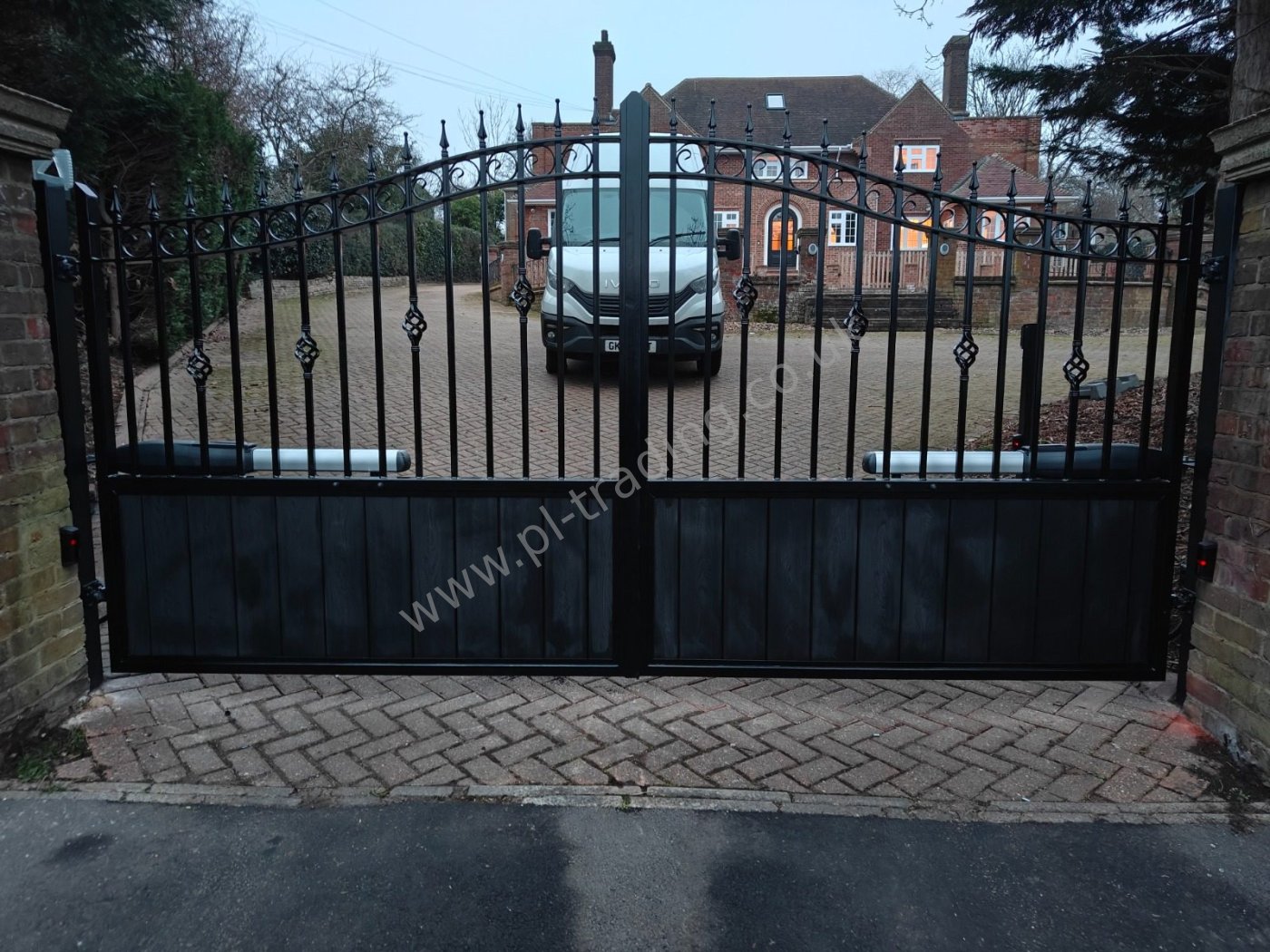
Short answer: driveway gates in London range from simple manual timber gates from around £800 to fully bespoke automated steel systems exceeding £10,000. The right choice depends on your security needs, driveway layout, budget and whether you want manual or electric operation. This guide covers every option — materials, types, costs and what to look for in an installer.
Manual vs electric driveway gates: which is right for you?
Manual driveway gates
Manual gates are opened and closed by hand. They cost less to buy and install, have no electrical components to maintain or replace, and work reliably without a power supply. The trade-off is convenience — you have to get out of the car every time. Manual gates make sense where budget is the main concern, where the gate is used infrequently, or where the driveway is shared and always left open during the day.
Electric driveway gates
Electric gates open and close automatically via remote fob, keypad, intercom or smartphone app. They add convenience and a significant security benefit — a gate that closes automatically behind you is far more effective than one that relies on someone remembering to shut it. Most systems include a backup battery so the gate still works in a power cut. Electric gates cost more upfront but are the standard choice for any property where security and daily convenience matter.
Types of driveway gates
Swing gates
Two leaves hinged to posts or pillars, opening inward or outward. The most common type for residential driveways in London. Swing gates are usually the cheapest option and suit level driveways with enough depth for the leaves to open fully — typically 1–2 metres per leaf. On sloped driveways the bottom of the gate can scrape the ground unless the geometry is carefully managed.
Sliding gates
A single panel that slides parallel to the fence or wall. Ideal where there is not enough depth for swing gates, or where the driveway slopes. Sliding gates need a clear run of space beside the opening equal to the gate width — a 4-metre gate needs around 4.5–5 metres of clear boundary. They cost more than swing gates due to the track or foundation required, but they are very secure and suit busy entrances well.
Bi-fold gates
Each leaf folds in half, needing only half the clearance of a standard swing gate. A practical solution for driveways where depth is limited. Bi-fold gates move faster than standard swing gates and are popular on commercial entrances where throughput matters.
Single gate
Where the driveway is narrow enough, a single gate leaf can cover the full opening. Common on terraced properties in London where the entrance is 2–3 metres wide. A single gate is cheaper and simpler to automate than a pair.
Gate materials: steel, timber, aluminium and wrought iron
Steel
The most popular choice in London for new driveway gates. Steel is strong, secure and long-lasting. Bespoke steel gates can be designed in any style from simple vertical bars to decorative panels. Hot-dip galvanising or a quality primer and topcoat finish protects against rust for many years. Steel gates are heavier than aluminium, but modern electric motors handle this easily.
Timber
Timber gates have a traditional look that suits period properties and rural settings. Hardwood (oak, iroko) lasts longer than softwood and takes a stain well. The downside is that timber swells and shrinks with moisture, which can cause electric gates to bind seasonally. Timber also needs more maintenance than steel — repainting or re-oiling every few years.
Aluminium
Aluminium gates are lightweight, rust-proof and low maintenance. Popular for modern designs with flat bars or solid cladding panels. Lighter weight means less stress on posts and motors, and smaller motors can be used. The main limitation is that aluminium is softer than steel and more easily damaged by impact.
Wrought iron
Traditional wrought iron gates are decorative and very durable. In practice most “wrought iron” gates sold today are mild steel with a decorative finish — true wrought iron is expensive and rarely used for new installations. Steel gates with scroll and finial detailing give the same look at a fraction of the cost.
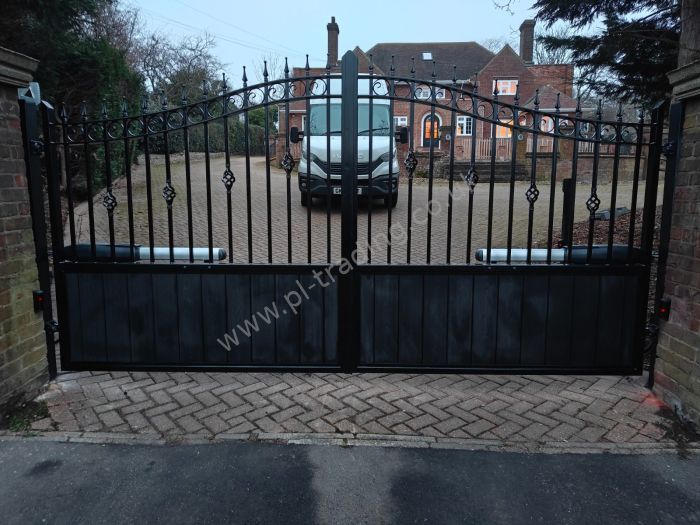
Driveway gate prices in London
| Type of job | Rough guide price |
|---|---|
| Manual timber or steel swing gates (pair, 3–4 m driveway) | from around £800–£2,500 |
| Adding electric automation to existing sound gates | from around £2,000 |
| New electric steel swing gates (pair, 3–4 m driveway) | from around £3,000–£5,000 |
| New electric sliding gate | from around £5,000–£8,000 |
| Bi-fold electric gates | from around £6,000–£10,000 |
| Pedestrian side gate (matching design) | from around £800–£1,500 |
| Intercom, keypad or app control | £300–£2,500 extra |
Properties in inner London typically pay 15–20% more due to access, parking and labour costs.
Planning permission for driveway gates in London
In England, driveway gates are usually permitted development — no planning application needed — if they are no higher than 1 metre adjacent to a road used by vehicles, or no higher than 2 metres elsewhere. You may need planning permission if:
- the gates will exceed these height limits,
- the property is a listed building,
- the property is in a conservation area or covered by an Article 4 direction (common across many London boroughs),
- the property is a flat or maisonette.
A good installer will raise this during the site survey. If creating a new dropped kerb at the same time, that needs separate council approval. Always confirm with your local borough planning department if you are close to the height limits or in a restricted area.
What to look for in a driveway gate installer
- Free site survey and written quote before any commitment.
- Experience with your gate type — swing, sliding and bi-fold gates each need different skills and equipment.
- Safety compliance — electric gates must meet BS EN 12453 and BS EN 12445. Ask how the gates will be safety-tested.
- Warranty — at minimum 12 months on installation, with the manufacturer’s warranty on motors and control boards.
- Local references or a portfolio of recent work — ask to see examples of similar installations.
Why choose PL Trading for driveway gates in London?
PL Trading designs, manufactures and installs bespoke steel driveway gates and electric gates across Greater London and the Home Counties. We make every gate to measure and can match railings and pedestrian gates to the same design. We handle everything from the initial survey through to groundworks, cabling, automation and safety testing. Have a look at our recent installations, then send us your details for a free, no-obligation quote.
Frequently asked questions
What types of driveway gates are available in London?
The main types are manual swing gates, manual sliding gates, electric swing gates and electric sliding gates. Bi-fold and cantilever gates are less common but suit specific driveway layouts. Steel is the most popular material for security and longevity; timber, aluminium and wrought iron are also widely used. PL Trading manufactures bespoke gates in steel and can advise on the best type for your driveway.
How much do driveway gates cost in London?
A pair of manual steel swing gates starts from around £1,500–£2,500 supplied and fitted. Adding electric automation starts from around £2,000 on top of that. A fully automated electric sliding gate typically starts from £5,000–£7,000 installed. Prices vary with size, design complexity, material and groundworks required.
Do I need planning permission for driveway gates in London?
Usually not. Gates up to 1 metre high adjacent to a road used by vehicles, or up to 2 metres elsewhere, are normally permitted development in England. Conservation areas, listed buildings and Article 4 directions are exceptions — check with your local borough before ordering.
How long do steel driveway gates last?
Well-made steel driveway gates with a quality primer and topcoat finish should last 20–30 years with basic maintenance. The main tasks are touching up paint chips promptly to prevent rust, lubricating hinges once or twice a year, and checking that posts remain solid. Electric motors and control boards typically last 10–15 years before needing replacement.
Can I add automation to my existing driveway gates?
Yes, in many cases. If the existing gates and posts are structurally sound and correctly hung, adding electric motors, a control board, safety devices and remote fobs is usually straightforward. A site survey will confirm whether your current gates are suitable. If the posts are weak or the gates are warped, replacing them at the same time is usually better value.